
By Sarah Ward
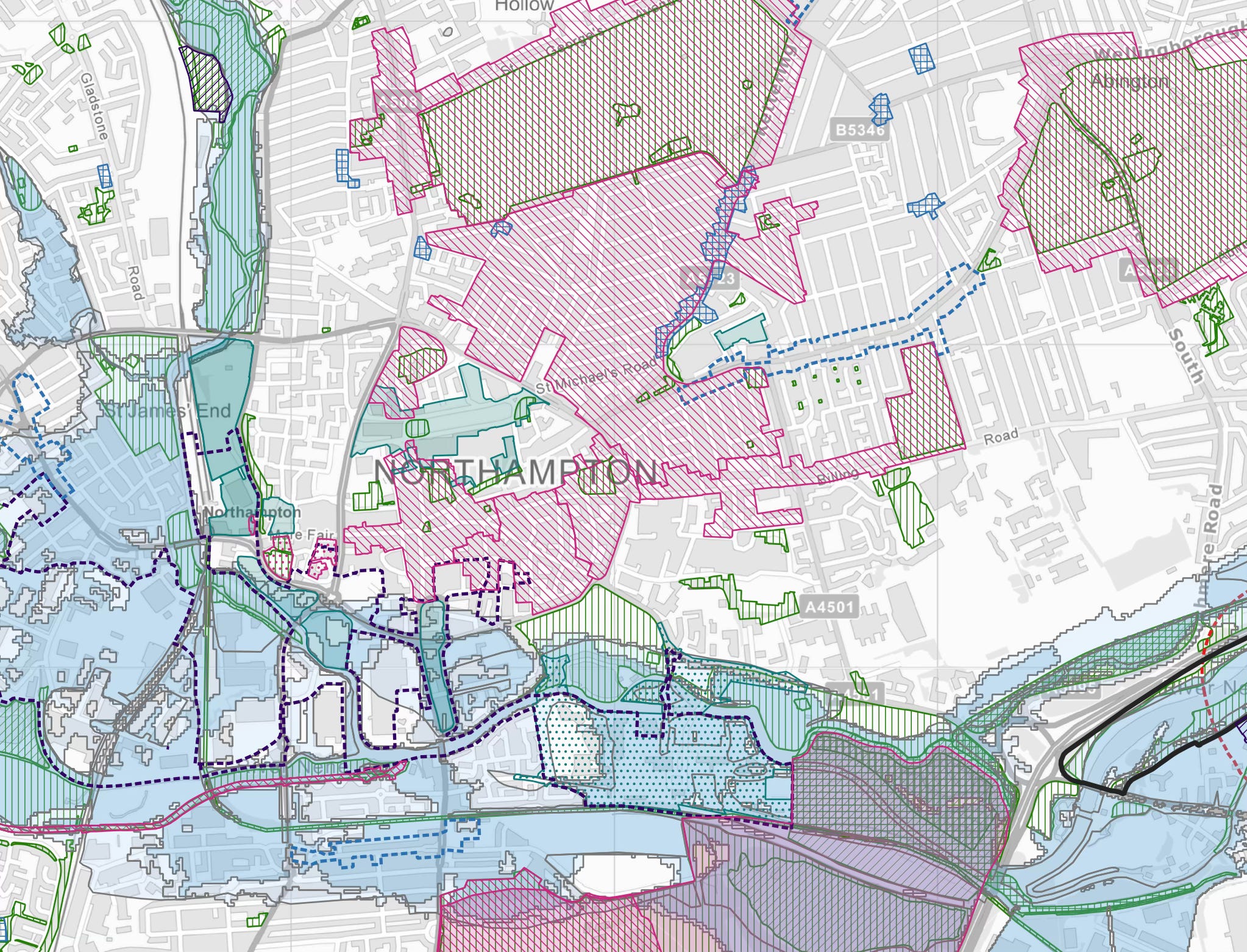
More than 45,000 new homes and a ten-story landmark building are among the proposals detailed in the new masterplan document for the Western half of Northamptonshire. After years of drafting and a reset in 2024 - when the then fledgling Labour government raised the numbers of homes it required to be built in the area by 20 per cent - the draft local plan has been published by West Northamptonshire Council and will go out to consultation next month.
A trawl through its 420 plus pages reveals that 47,300 homes are planned to be built by 2043, with a third of those in the county town. There are urban extensions to a number of the town’s edges, with the biggest settlements planned close to Moulton, west of the A43 (2,900 homes) and to the east of the road, near Whitehills there is another 1,950 new settlement planned. Close to Brackmills in the south of the town there could be 1,000 homes built on land north of Newport Pagnell Road and north of the Buckton Fields development there could be another 1,500 homes.
Within the centre there are plans for 733 homes as part of the Greyfriars development, which will include a landmark ten storey building, although the exact location has not been outlined.
While Northampton will take around a third of the planned homes the towns of Daventry, Brackley and Towcester will also see new development (an extra 4,670 homes are planned for Daventry, with the majority of those in an urban extension to the north east of the town) and the larger villages will also feature development including 242 homes intending for Brixworth, 126 for Bugbrooke and 168 for Deanshanger.
To achieve the building goal, just over 2,500 homes must be built each year, which the authority says is a quarter more than have been delivered on average over the past five years.
Before it comes into effect there are a few more stages to go through, ending with a public examination by a government appointed planning inspector, who can send the authority back to revisit some of the proposals if they don’t think it is sound.
The meat of the local plan has been devised under the previous Conservative administration that ran the authority from 2021 until May 2025, and much like in other areas, the new Reform UK leadership has decided to pick up the baton and carry on, without any seeming radical departure from what its political rivals had proposed.

In a statement issued by the authority this week, cabinet member for planning Cllr Thomas Manning said:
“The local plan is one of the most important documents we produce, setting out how we balance homes, jobs and infrastructure, while protecting our environment and creating thriving places for future generations.
“The views of residents, parishes and businesses will be vital in shaping the final plan and I strongly encourage everyone to get involved when the consultation opens in February.”
Northampton metamorphosis?
The latest census figures from 2021, estimated that 236,000 people live in Northampton, which is more than half of the entire population of the WNC area (which the census says is 425,725). The town’s population has doubled since the 1960s and since 2011 its population growth has significantly outpaced the national average, with a 13.5 per cent growth. In the central area (the town centre) the numbers of people living there since 2011 has doubled to 22,500 people (at 2021).


The large scale development planned for the town centre will increase this significantly. Labour councillor Sally Keeble, who represents the Dallington Spencer ward, says more homes are definitely needed, but locations need to be well thought out and the public need to be involved in the process.

She said:
“You can’t do regeneration to people - you have to do it with them. Northampton bears all the scars of bad regeneration, from the Eastern district being plonked onto the town; the town centre regeneration has not lasted and old communities were ripped out.
“There is no denying there is a need for new housing, but we need to think about what type of housing it is.
“Parts of Northampton suffer from not having enough high quality housing, which then fails to attract people to move there and are concerns about the concentration of HMOS (homes of multiple occupation) in some areas and the impact that has had.
“There is an emphasis on affordable, but we need more social housing. Planning is not a neutral activity. It shapes things for years to come.”
New homes in rural areas
The local plan seeks to classify the area’s hundreds of villages into primary, secondary and other, with policies attached to each. The primary villages have been named as Brixworth, Bugbrooke, Crick, Deanshanger, Long Buckby, Middleton Cheney, Roade, Weedon and Woodford Halse.
Secondary villages are Badby, Barby, Blakesley, Blisworth, Boddington (Upper), Boughton, Brafield on the Green, Braunston, Byfield, Chacombe, Chipping Warden, Charlton, Cogenhoe, Creaton, Croughton, Culworth, Denton, East Haddon, Farthinghoe, Flore, Greatworth, Greens Norton, Guilsborough, Hackleton, Harpole, Hartwell, Kilsby, Kings Sutton, Kislingbury, Little Houghton, Milton Malsor, Naseby, Nether Heyford, Old Stratford, Pattishall (Astcote and Eastcote), Paulerspury, Pitsford, Potterspury, Silverstone, Spratton, Staverton, Stoke Bruene, Syresham, Walgrave, Welford, West Haddon, Yardley Gobion, Yardley Hastings, Yelvertoft.
Almost all villages have a housing allocation attached to them, with more development planned for the larger villages. The aim is to keep the developments within the village confines although there are exceptions about schemes that may be just attached to the boundary and if there is not a five year land supply, developments may be granted. As at last April, the authority could demonstrate a 5.5 year land supply and is therefore currently safe from speculative developments.

Liberal Democrat councillor Jonathan Harris, who represents Brixworth, is on the planning policy committee and says much of what is in the plan is not a surprise, although the housing allocations numbers for the villages are.
He said:
“One of the key questions I have, is how have the numbers been arrived at?
“In the last ten years somewhere around 300 homes have been built in Brixworth and now we have had another 242 allocated. Without really any thinking it through.
“I suspect it is about land availability. I am not against development in the rural areas as I think we have to. Creaton lost a school and that can be what starts to happen in the villages, with pubs and post offices lost. I am not adverse to development but it has to be with local input and it cant be forced on people. It also has to be relative to what has gone before.”
Opposition
From next month residents and interested parties will be able to give their views. Overstone Parish Council has already published its objection to the plans 2,900 nearby at land north of the A43. It wants the allocation removed entirely as it says there is not sufficient capacity in the nearby areas of Moulton to cope with the increase in population. It also points to what it calls “WNC’s real world delivery record’ in the immediate area, which shows ‘material under delivery of infrastructure relative to population growth.’ It also has concerned about identified archaeology and says surveys carried out a decade ago found extensive Bronze and iron age activity in several nearby sites.
The draft local plan will be discussed by the council’s planning policy committee tomorrow night (Jan 8), which is expected to approve it for consultation. The draft local plan for the north of the county is expected to be published in coming weeks.
You can read the West local plan in full here.
Northampton General Hospital has grown organically over the decades, with extra buildings tacked on here and there, sometimes connected by corridors. It must be a real headache to manage the maintenance of such an aging, sprawling site. As our demographic profile shifts to an older population our healthcare needs are only going to increase.
West Northants would greatly benefit from a brand new hospital campus built on a new site. It would be a long-term and expensive project, but it could benefit from all the latest building technologies to be clean, convenient and energy efficient, improving the experience of staff and patients alike.